
This type of agent reacts instantly to what it senses in its environment, just like a human reflex (for example, blinking your eyes when something comes close).
What It Is:
A Simple Reflex Agent is the most basic type of AI agent.
It works by reacting instantly to what it sees right now — without thinking about the past or planning for the future.
👉 Think of it as a “see something → do something” machine.
How a Simple Reflex Agent Works
Let’s understand this with the help of the diagram 👇
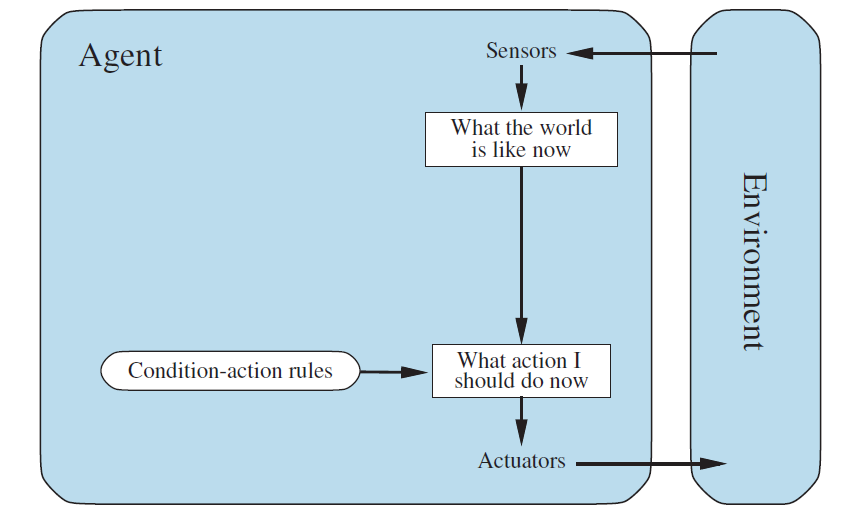
- Environment → Sensors
- The environment is the outside world (like a room, road, or game).
- The sensors observe the environment and send information to the agent.
- Example: A vacuum cleaner’s dirt sensor detects whether the floor is dirty or clean.
- Sensors → “What the world is like now”
- The agent receives the current situation — what’s happening right now.
- It forms a percept, such as “there is dirt here.”
- The agent doesn’t use memory or past experiences — only the current input matters.
- Condition–Action Rules
- Inside the agent, there are simple rules stored like:
- IF condition → THEN action
- Example:
- IF dirt is present → THEN clean
- IF no dirt → THEN move forward
- The agent checks these rules to decide what to do next.
- Inside the agent, there are simple rules stored like:
- “What action I should do now” → Actuators
- Once the agent selects an action, it sends a command to its actuators (the parts that move or act).
- Example: The vacuum turns on its motor to clean, or moves to another spot.
- Actuators → Environment
- The action affects the environment — for instance, the floor becomes clean.
- Then the process repeats continuously:
- Sense → Decide → Act → Sense again.
Cycle Summary (from the diagram)
Environment → Sensors → Condition-Action Rules → Actuators → Environment
This loop keeps running until the task is done.
In Simple Words:
A Simple Reflex Agent just reacts instantly based on what it senses right now, using fixed rules.
It doesn’t learn, remember, or plan ahead — it’s like a reflex action (e.g., blinking when something comes near your eyes).
If you touch something hot, you pull your hand away instantly. You don’t stop to think about it — that’s how this agent works!
Example 1 – Vacuum Cleaner Robot
- Percept: The robot senses whether the current square is dirty or clean.
- Action:
- IF dirty → Suck
- IF clean → Move right
👉 It ignores the past (like whether it already cleaned the left side).
That’s why it’s called a reflex agent — just like when you blink automatically.
Summary Table
| Feature | Description | Example |
| Basis of action | Current percept only | “If dirty → suck” |
| Memory | None | Does not remember past |
| Learning | None | No improvement over time |
| Advantages | Simple, fast, works in fully observable environments | Vacuum agent |
| Limitations | Fails if info is incomplete or environment changes | Misses unseen dirt |
Limitations of Simple Reflex Agents (with More Examples)
Simple reflex agents are quick and simple — but they can easily fail in complex or changing environments.
Example 1: Self-Driving Car
- Rule: If red light → stop
- Problem: What if the traffic light is covered by fog or malfunctioning?
The car can’t “guess” based on past experience or other clues — it only reacts to what it currently sees.
➡️ Limitation: Fails when the environment is partially observable.
Example 2: Vacuum Cleaner
- Rule: If dirty → suck, else → move right
- Problem: What if it starts in the rightmost corner and keeps moving right forever?
It never remembers that it has already cleaned that area.
➡️ Limitation: Gets stuck in loops or misses unclean areas.
In Short
| Limitation | Meaning | Example |
| No memory | Cannot remember past actions | Vacuum repeats same move |
| No learning | Cannot improve from experience | Game bot keeps dying same way |
| Partial observability | Fails when info is missing | Self-driving car in fog |
| Infinite loops | Repeats same action forever | Vacuum stuck in corner |
| No context awareness | Acts blindly | Smart light triggered by curtain |
Imagine you only react to what you see right now — no memory, no thinking, no learning.
You’d bump into the same wall again and again! That’s exactly what happens to a simple reflex agent.