
By seeing tis example below, Imagine you are a tourist in Romania. You are standing in the city of Arad, and you must reach Bucharest to catch your flight tomorrow morning.
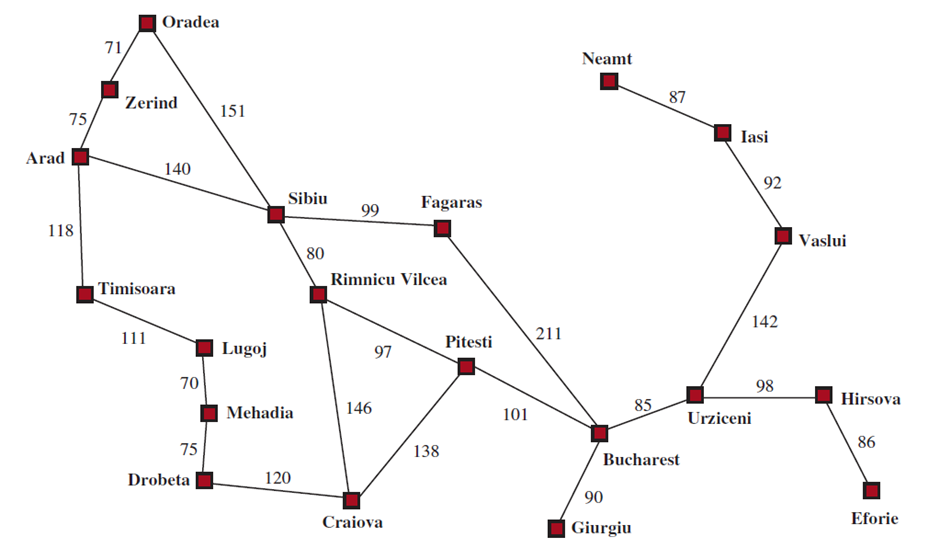
You can go to Sibiu, Zerind, or Timisoara — but which road will get you to Bucharest fastest
This is exactly what an AI problem-solving agent faces — a situation where it must decide what to do to reach a goal.
What is a Problem-Solving Agent?
A problem-solving agent is an intelligent system that:
- Thinks before it acts.
- Plans a sequence of actions to reach its goal.
- Executes those actions in the real world.
It follows four clear steps
1️⃣ Goal Formulation
The agent decides what it wants to achieve.
Example: Reach Bucharest.
Why is goal setting important?
Because it tells the agent what to focus on — it doesn’t have to think about sightseeing or food, only the goal.
2️⃣ Problem Formulation
The agent now describes the world as a simple model — only the parts that matter for solving the problem.
this is like making a simplified version of reality.
| Concept | Example |
| State space | All cities on the map (Arad, Sibiu, Fagaras, etc.) |
| Initial state | Arad |
| Goal state | Bucharest |
| Actions(s) | Move from one city to another connected by a road |
| Transition model | What happens when you take an action (e.g., RESULT(Arad, ToSibiu) = Sibiu) |
| Action cost | Distance between cities (in miles) |
💡 Example:
- ACTIONS(Arad) = {ToSibiu, ToTimisoara, ToZerind}
- ACTION-COST(Arad, ToSibiu) = 140 miles
So, the agent’s problem is to find a path (a series of actions) that goes from Arad → Bucharest with the least total cost.
3. Search (Thinking Before Acting)
The agent doesn’t just move randomly — it searches for the best path.
It uses the map (knowledge) to explore all possible routes.
Example of possible paths:
1️⃣ Arad → Sibiu → Fagaras → Bucharest
- Total cost = 140 + 99 + 211 = 450 miles
2️⃣ Arad → Sibiu → Rimnicu Vilcea → Pitesti → Bucharest
- Total cost = 140 + 80 + 97 + 101 = 418 miles
3️⃣ Arad → Timisoara → Lugoj → Mehadia → Drobeta → Craiova → Pitesti → Bucharest
- Total cost = 118 + 111 + 70 + 75 + 120 + 138 + 101 = 733 miles
So, the second route (via Sibiu → Rimnicu Vilcea → Pitesti) is shortest.
✅ Optimal Path: Arad → Sibiu → Rimnicu Vilcea → Pitesti → Bucharest
✅ Cost: 418 miles
4️⃣ Execution (Acting Stage)
4. Execution
Now that the agent has planned the route, it actually executes it:
Drive Arad → Sibiu → Rimnicu Vilcea → Pitesti → Bucharest.
If the world is perfect (no roadblocks, no mistakes), the agent can simply follow the plan — this is called an open-loop system (no need to keep checking).
If the world changes (road closed, traffic jam), the agent must adjust — that’s a closed-loop system, where it monitors and adapts.
Summary Table
| Step | What Agent Does | Example |
| 1. Goal Formulation | Decides what it wants | “Reach Bucharest” |
| 2. Problem Formulation | Describes the environment | Cities, distances, roads |
| 3. Search | Finds the best path | Arad → Sibiu → Rimnicu Vilcea → Pitesti → Bucharest |
| 4. Execution | Follows the chosen path | Drives city by city |
how AI agents think and plan using:
- State space (possible situations)
- Actions (choices)
- Goal (what to achieve)
- Search algorithms (how to reach the goal efficiently)
Why Abstraction Is Important
In real life, traveling involves:
- Traffic
- Weather
- Food breaks
- Music
- Road conditions
But for AI, we remove all these extra details and keep only what’s important — cities and distances.
This is called abstraction — simplifying reality so the AI can focus on solving the right problem.