
In the previous section, we discussed Mean Squared Error (MSE). Although MSE is mathematically useful, its squared units make it difficult to interpret. To overcome this limitation while keeping the advantage of penalizing large errors, we use Root Mean Squared Error (RMSE).
What is RMSE?
Root Mean Squared Error (RMSE) is the square root of Mean Squared Error.
RMSE measures the average prediction error while giving extra importance to large mistakes, and it expresses the error in the original unit of the target variable.
In short:
- MSE → good for math
- RMSE → good for humans
RMSE Formula

Where:
- yi= actual value
- yi= predicted value
- n= number of observations
Step-by-Step Numerical Example (Delivery Time)
Dataset (Including an Outlier)
| Delivery | Actual (days) | Predicted (days) | Error | Squared Error |
| 1 | 2.0 | 2.2 | 0.2 | 0.04 |
| 2 | 3.0 | 2.9 | 0.1 | 0.01 |
| 3 | 1.5 | 1.6 | 0.1 | 0.01 |
| 4 | 4.0 | 3.8 | 0.2 | 0.04 |
| 5 | 5.0 | 8.0 | 3.0 | 9.00 🚨 |
Step 1: Compute MSE

step 2: Take Square Root
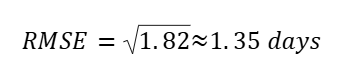
Interpretation of RMSE
RMSE = 1.35 days means that, on average, the model’s predicted delivery time deviates from the actual delivery time by about 1.35 days, with large delays having a strong influence.
Compare this with MAE:
- MAE showed typical error
- RMSE highlights serious mistakes
Why Taking Square Root Is Important
Problem with MSE
- Units are squared (days²)
- Hard to interpret
RMSE Solution
- Square root cancels squared unit
- Final unit = days
This makes RMSE:
Mathematically strong and human-readable
Advantages of RMSE — Explained Clearly
Penalizes Large Errors Strongly
Why is this an advantage?
- Squaring makes big errors much larger
- Taking root does not remove the penalty effect
Example:
- Error = 0.2 → small impact
- Error = 3.0 → dominates RMSE
This ensures:
Models with dangerous mistakes are clearly identified
More Interpretable Than MSE
Why is this an advantage?
- RMSE is in the same unit as output
- Humans understand days, marks, rupees—not squared units
Example:
- RMSE = 1.35 days → meaningful
- MSE = 1.82 days² → confusing
Widely Accepted Standard Metric
Why is this important?
- Used in research papers
- Used in industry
- Default metric in many tools
Students will see RMSE again and again.
Useful for Risk-Sensitive Applications
Why?
Because:
- One extreme mistake can cause big loss
- RMSE exposes such risks
Example:
- Medical dosage
- Engineering loads
- Financial risk
Disadvantages of RMSE — Explained Clearly
Highly Sensitive to Outliers
Why is this a disadvantage?
- One rare extreme case can inflate RMSE
- Typical performance may look worse than reality
Example:
- One flood-delayed delivery affects entire score
Can Be Misleading for Average Performance
Why?
- RMSE focuses on worst errors
- Average daily performance may actually be good
Businesses may panic unnecessarily.
Harder to Explain Than MAE
Why?
- Involves squaring and square root
- Non-technical users prefer MAE
RMSE is better for engineers than managers.
When Should We Use RMSE?
Use RMSE when:
✔ Large errors are dangerous
✔ Worst-case performance matters
✔ Safety or cost is critical
✔ You want to detect serious failures
When Should We Avoid RMSE?
Avoid RMSE when:
Outliers are frequent and unavoidable
Typical performance matters more
Simple explanation is required
Use MAE instead.
RMSE measures average prediction error while strongly penalizing large mistakes and expressing the result in original units, making it ideal for applications where big errors are costly.
Compare RMSE with a Baseline Model (Most Important)
What is a baseline?
A simple model that predicts:
- Mean of the target variable
Example:
| Model | RMSE |
| Baseline (mean prediction) | 2.8 |
| ML Model | 1.35 |
Since:
1.35<2.81.35 < 2.81.35<2.8
The ML model is clearly better.
A model is good if it beats the baseline.
Method 3: Compare RMSE Across Multiple Models
You usually train many models, not just one.
| Model | RMSE |
| Linear Regression | 1.9 |
| Decision Tree | 1.6 |
| Random Forest | 1.35 |
The lowest RMSE wins.
RMSE is mainly used for model comparison, not absolute judgment.