
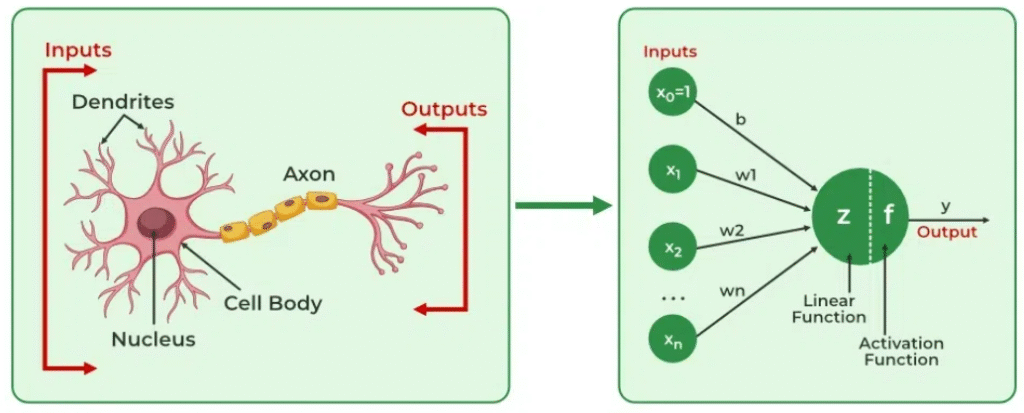
We just saw how your brain neurons pass messages:
Dendrites listen.
Cell body decides.
Axon passes the message forward.
Synapse connects to the next neuron.
Scientists thought:
“If the brain can learn by connecting neurons together, maybe we can build computers that ‘think’ in a similar way!”
So they created Artificial Neural Networks (ANNs).
How ANN copies the brain
- In ANN, inputs are like dendrites.
Example: For a picture of a cat , inputs are the pixels (tiny dots of the image). - Each input has a weight (like importance).
In the brain, some signals are stronger than others. In ANN, weights decide which input matters more. - Then comes the summing point (like the neuron’s cell body).
It adds everything up: important signals + bias. - Next, an activation function acts like the brain’s decision-making spark ⚡.
It decides: Should I pass this signal forward or not? - Finally, the signal travels to the next layer of artificial neurons, just like biological neurons passing signals through synapses.
Example
Imagine training an ANN to recognize “Fire” from an image:
Inputs = image pixels (red, orange, yellow shades).
Weights = give more importance to “red + yellow” parts.
Activation function = if enough of these colors are present, the neuron fires.
Output = “Yes, this looks like fire.”
So just like your brain neurons helped you move your hand away from a flame,
ANN neurons help a computer recognize fire in a photo or video.
Final Line
ANNs are just computer programs inspired by how your brain’s neurons work—taking inputs, deciding, and passing signals forward to solve problems like recognizing images, sounds, or even making decisions.