Have you ever noticed that your life already runs on a decision tree?
- If it’s raining → take an umbrella
- Else if it’s sunny → take sunglasses
- Else → just pray and go out
Congratulations! You just built your first Decision Tree without knowing any machine learning.
In machine learning, computers do the same thing—except instead of umbrellas, they predict things like “Will the student pass?” or “Will we play tennis today?”
Imagine you are hungry.
- If money > 200 → order pizza
- Else if money > 50 → eat samosa
- Else → drink water and sleep
This “food selection logic” is exactly how a Decision Tree works.
In this blog, we’ll see how machines make decisions step by step using a Decision Tree
- Introduction
- What is a Decision Tree?
- Structure of decision tree Components (root, node, leaf)
- How splitting works
- Entropy / Gini (with intuition)
- Example (Play Tennis)
- Summary
What is a Decision Tree?
A Decision Tree is a supervised machine learning algorithm used for classification and regression.
It works by splitting data step by step based on conditions and finally giving an output.
It looks like a tree structure, where:
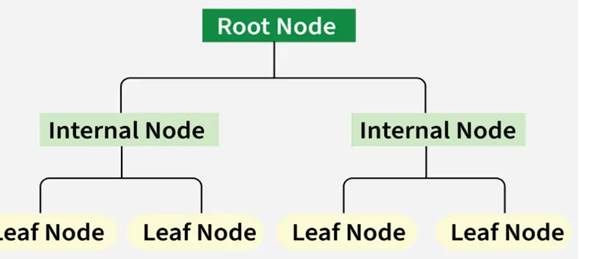
- Each internal node represents a decision
- Each branch represents an outcome of the decision
- Each leaf node represents the final output
Real-Life Example
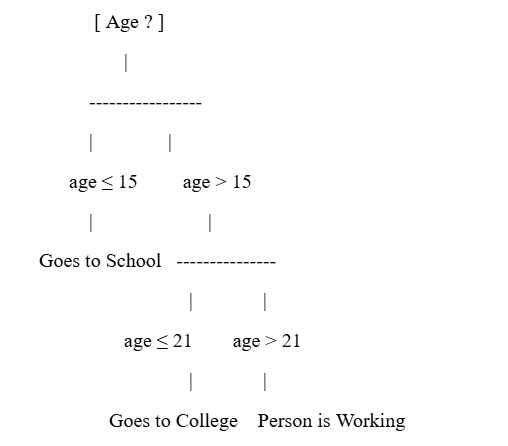
Consider deciding a person’s education based on age:
- If age ≤ 15 → Goes to School
- If age > 15 and age ≤ 21 → Goes to College
- Else → Working
This decision-making process can be represented using a decision tree.
Structure of a Decision Tree
(a) Root Node
- The top-most node
- Represents the first decision
- There is only one root node
(b) Child Node (Decision Node)
- Comes from the root or another child
- Represents further decisions
- There can be many child nodes
(c) Leaf Node
- Represents the final output
- Does not split further
- All outputs come from leaf nodes
4. Important Points
- A decision tree starts from the root node
- It follows conditions until it reaches a leaf node
- There can be many leaf nodes
- There can be only one root node
- Leaf nodes give the final result/output
Decision Tree as Flow of If–Else Conditions
A decision tree works similar to if–else statements in programming.
Example:
if age <= 15:
print(“Person goes to school”)
elif age > 15 and age <= 21:
print(“Person goes to college”)
else:
print(“Person is working”)