
Neuron Structure
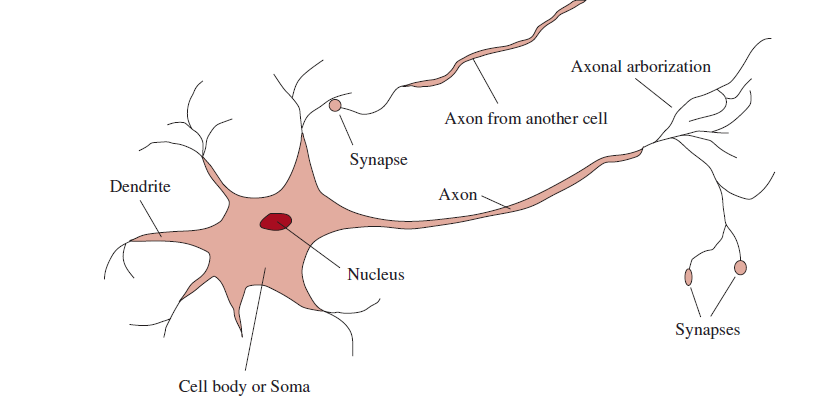
Cell body (soma) → The “main office” of the neuron. It has the nucleus, which acts like the control center.
Dendrites → Short, branching fibers. They receive signals from other neurons, like little antennas.
Axon → A single, very long fiber. It carries signals away from the neuron to the next one.
The axon can be very long—sometimes up to 1 meter! (Imagine from your spinal cord to your toe).
Synapses → Junctions where one neuron connects and communicates with another neuron.
How it works
Signal reception → Dendrites receive signals from other neurons.
Signal processing → The cell body combines all the incoming signals.
Signal transmission → If the signal is strong enough, the axon carries it forward.
Communication → At the synapse, the signal is passed to the next neuron using electrochemical reactions.
Important Facts
A single neuron can connect with 10 to 100,000 other neurons!
These connections form a giant network inside your brain.
Signals between neurons are both electrical (along the axon) and chemical (at the synapse).
This network controls:
Short-term activity (like moving your hand).
Long-term changes (like learning something new).
Where does this happen?
Most of this processing happens in the cerebral cortex (the wrinkly outer layer of your brain).
The cortex is organized into columns of about 0.5 mm wide and 4 mm deep.
Each column has about 20,000 neurons—and millions of these columns work together.
U can imagine this with the story
Inside your brain, there lived a little messenger called Neuron.
Story to remember
Neuron had a big round house called the cell body (soma). At the center of the house was the nucleus, which acted like Neuron’s boss, telling him what to do.
From his house, Neuron had many little branches sticking out, called dendrites. These were like ears—always listening to what his neighbors (other neurons) were saying.
Neuron also had a very long tail called the axon. This tail could stretch super far—sometimes all the way from your back to your toes! At the end of the tail, it split into many smaller branches called axon terminals, which could talk to thousands of other neurons.
But Neuron didn’t shout his messages. Instead, he used a secret code—tiny electrical sparks that ran down his axon. When the spark reached the end, Neuron whispered the message across a tiny bridge called a synapse. On the other side, another neuron picked it up with its dendrites.
And so, Neuron passed on important news:
- “Move your hand!”
- “Remember this math formula!”
- “You’re feeling happy right now!”
Neuron and his friends were hard workers. Each one could connect with 10 to 100,000 other neurons. Together, they made a giant city inside your head called the brain.
At the top of this city lived the cerebral cortex—the smart part of the brain. It was like a huge library filled with columns of neurons, each column packed with 20,000 little messengers working together.
This is how Neuron and his friends help you think, learn, and remember—every single day.
Moral of the story:
Your brain is made of billions of tiny messengers (neurons). They pass signals to each other to control your actions, thoughts, and learning—just like a team that never sleeps!
How signals travel between neurons
- Inside a neuron (electrical)
- The neuron sends signals along its axon as tiny electrical impulses.
- This is called an action potential (like a little spark ⚡ running down a wire).
- So, information inside one neuron moves in an electrical form.
Between neurons (chemical)
At the end of the axon, the signal reaches a tiny gap between neurons called the synapse.
Neurons don’t touch directly; instead, the electrical signal triggers the release of chemicals (called neurotransmitters).
These chemicals cross the synaptic gap and bind to the next neuron’s receptors.
Once received, they can start a new electrical signal in the next neuron.
So:
Electrical → inside the neuron (axon)
Chemical → between neurons (synapse)
Imagine:
- A neuron is like a railway station.
- Inside the station, trains (electrical signals) move quickly along the tracks (axon).
- But when the track ends, there’s a river gap (synapse).
- To cross the river, you need a boat (chemical neurotransmitter).
- Once across, trains can run again on the next track.
That’s why we say:
“Signals are electrical along the axon, but chemical at the synapse.”
At the synapse (the tiny gap between two neurons), the message has to jump from one neuron to the next.
This happens through a mix of electrical and chemical processes — that’s why we call it electrochemical.
When situation occurs (How your neurons react)
The Finger-Burn Story
One day, you accidentally touched a hot stove with your finger.
Instantly, the sensors in your skin felt the heat. They sent an emergency message to the neurons.
The dendrites of a sensory neuron received this signal: “It’s burning!…it is hot”
The signal rushed through the cell body and ran down the axon like an electric current.
At the end, across the synapse, the message jumped to the next neuron.
This chain of neurons carried the signal super-fast to your spinal cord and brain.
Your brain read the message and quickly sent another order back:
“Move your hand away!”
That return message traveled down a different set of neurons—called motor neurons—all the way to the muscles in your hand.
In a fraction of a second, your muscles pulled your hand away before your skin could get badly burned.
Neurons are like an emergency telephone line in your body.
Sensory neurons: pick up the danger (the heat).
Brain/spinal cord neurons: decide what to do.
Motor neurons: carry the order to your muscles.